
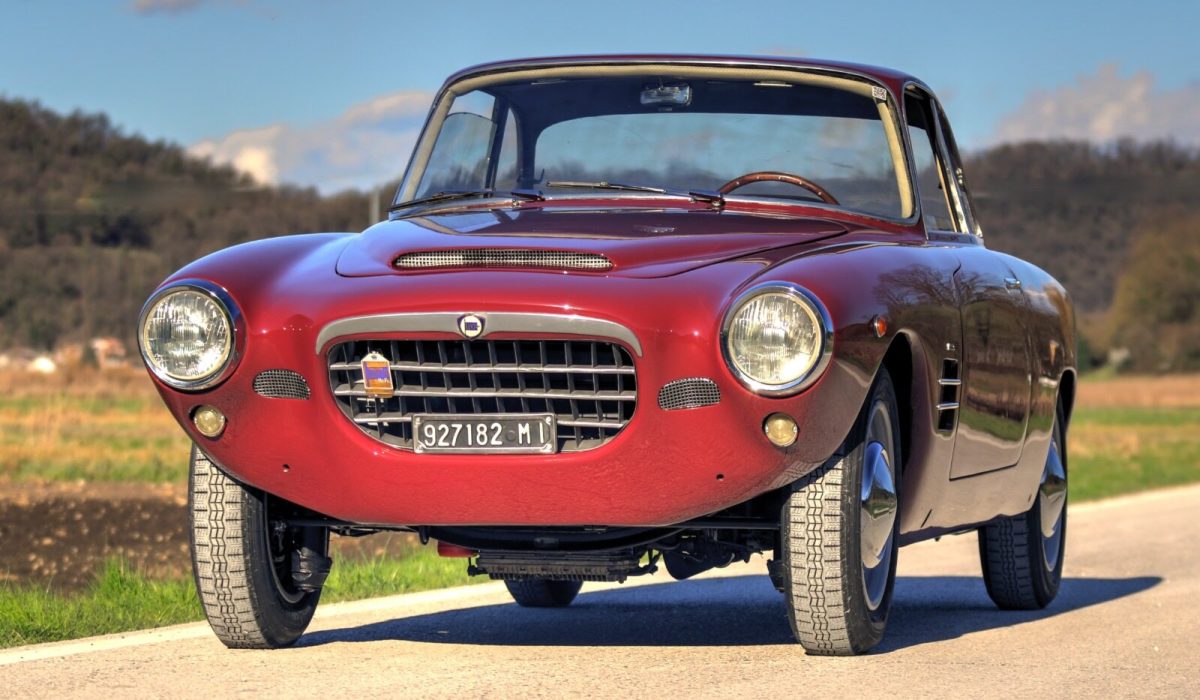
The 1957 Lancia Appia Sport Motto is one of the rarest and most fascinating interpretations of the Lancia Appia, combining sophisticated Lancia engineering with a lightweight hand-built aluminium body by the Turin coachbuilder Rocco Motto.
This particular car, chassis 812.01-1031, is believed to be the only surviving example from an estimated production of ten Motto-bodied Appias. Contemporary research also identifies it as likely the final Appia chassis completed by Motto.
The car has previously been handled by Giro Classico and is now part of our archive of significant collector cars sold to enthusiasts around the world. Giro Classico also lists the 1957 Lancia Appia Sport Motto among the important historic cars that have passed through the company.
1957 Lancia Appia Sport Motto
The standard Lancia Appia was already an unusually sophisticated small car for its period.
Introduced during the 1950s, it reflected Lancia’s traditional engineering philosophy through:
- compact dimensions
- relatively low weight
- refined suspension
- a narrow-angle V4 engine
- rear-wheel drive
- high-quality construction
- advanced engineering for its class
The Motto-bodied Sport transformed that elegant small saloon concept into something much more focused.
Instead of the conventional Appia body, Rocco Motto created a compact aluminium coupé with proportions and construction clearly influenced by competition cars.
Coachwork by Rocco Motto
Rocco Motto was one of the most interesting independent Italian coachbuilders of the post-war period.
Unlike larger firms that concentrated mainly on production road cars, Motto became particularly associated with:
- lightweight aluminium bodies
- sports cars
- competition specials
- one-off projects
- very small production runs
His work appeared on Italian and foreign chassis and included cars intended both for road use and competition.
The Appia Sport is one of the clearest examples of his philosophy: use lightweight aluminium construction to extract more performance from relatively modest mechanical components.
An aluminium-bodied Lancia Appia
The most important difference between a conventional Appia and the Motto Sport is its body.
Historical documentation describes chassis 812.01-1031 as one of approximately ten Appias clothed by Motto in aluminium.
The design is characterised by:
- a very compact passenger compartment
- long front and rear sections
- extensive use of aluminium
- pronounced side vents
- large glass areas
- lightweight construction
- a low and purposeful profile
Because these bodies were effectively hand-built, individual examples could differ in details.
That makes original bodywork, trim and period photographs particularly important when assessing a Motto Appia today.
Chassis 812.01-1031
This specific car carries chassis number:
812.01-1031
and is documented with engine number:
814.00*1014.
The car is believed to be the tenth Motto-bodied Appia produced, and the marking “010” found in the engine compartment has been interpreted as supporting that position in the production sequence.
Because the surviving documentation indicates approximately ten examples were originally built, this makes chassis 812.01-1031 particularly significant.
Possibly the only surviving Motto Appia
Both auction documentation and later historical research identify this car as probably the sole surviving example of the small series of Motto-bodied Appias.
When describing a car of this rarity, however, careful wording matters.
For SEO and historical accuracy, the best formulation is:
“believed to be the only surviving example of approximately ten Motto-bodied Lancia Appias.”
This preserves the significance of the car without presenting an evolving historical register as an absolute fact.
One of the last sports cars bodied by Motto
Research on this chassis suggests that it may also have been the last Appia completed by Rocco Motto.
This is particularly interesting because the late 1950s marked the end of one phase of Motto’s activity.
During the post-war period he had become known for lightweight sports and competition coachwork, while the company would later diversify into other forms of production.
For a collector, the Appia therefore represents more than a rare Lancia: it belongs to the final period of one of Italy’s most distinctive specialist coachbuilders.
The Lancia Appia V4
Beneath the special body remained one of Lancia’s most characteristic engineering solutions: the narrow-angle V4 engine.
This compact engine architecture helped Lancia achieve:
- short overall engine length
- low weight
- efficient packaging
- smooth operation
- a distinctive mechanical character
The Appia was never intended to compete through displacement alone.
Its appeal came instead from the classic Lancia formula of engineering sophistication combined with low mass and excellent balance.
With the lighter Motto aluminium body, that philosophy became even more relevant.
A small Italian Grand Tourer with racing character
The Appia Motto occupies an unusual position.
It can be considered both:
- a compact Italian GT
- and a lightweight sports car with competition influence
Its design combines:
- enclosed coupé bodywork
- aerodynamic proportions
- low mass
- high visibility
- Lancia engineering
- coachbuilt construction
This makes it historically comparable not simply with other Appias, but with the broader world of Italian lightweight sports and GT cars of the 1950s.
Appia Motto and the Mille Miglia
The historical importance of the model is strengthened by its connection with the Mille Miglia.
Specialist documentation notes that the Motto-bodied Appia model competed in the 1957 Mille Miglia, and the specific chassis 812.01-1031 has been described as eligible for the modern event.
For any historic event, however, current eligibility should always be checked against the latest regulations and the documentation of the individual car.
The modern Mille Miglia is reserved for cars that participated, or could have participated, in the original speed editions held between 1927 and 1957.
For collectors interested in event use, this makes the Appia Motto particularly attractive.
A car built for historic rallies
This specific Lancia has a meaningful history in historic regularity events.
After an earlier restoration completed around 1993, the car was used by its Italian owner in regularity rallies, including events in northern Italy, before being stored from approximately 2003.
That history is particularly relevant because cars such as the Appia Motto are best understood not simply as static collector pieces, but as machines designed to be driven.
Restoration history
Historical research records an initial restoration around 1993. The car was later subjected to another extensive restoration between 2022 and 2023 after many years in storage.
The later work included attention to:
- aluminium bodywork
- paint
- brightwork
- mechanical systems
- engine
- suspension
- carburettor
- interior details
The body was stripped and refinished in a period-correct red, while steel brightwork was rechromed and aluminium components polished.
Preserving hand-built details
One of the greatest challenges when restoring a car such as the Appia Motto is not rebuilding the engine or repainting the body.
It is preserving pieces that simply cannot be purchased.
Examples include:
- handmade grille elements
- Motto badges
- aluminium body panels
- window frames
- original glass
- interior trim
- coachbuilder-specific details
Historical research notes that the car retains its original marked glass, while the rare Motto side emblems and handcrafted front grille required particular attention during restoration.
For a one-off or extremely low-production coachbuilt car, these components can be crucial to authenticity.
What to check before buying a Lancia Appia Motto
Acquiring a car of this type requires much more than a standard classic-car inspection.
A proper due-diligence process should consider:
- chassis number
- engine number
- Lancia production records
- Motto body identification
- aluminium body originality
- historic photographs
- restoration documentation
- period modifications
- suspension
- braking system
- steering
- V4 engine
- carburettor
- gearbox
- electrical system
- original glass
- badges and trim
- ownership history
- event history
Because so few Motto Appias were produced, the identity and continuity of the individual chassis are especially important.
Originality on a coachbuilt competition-related car
The meaning of originality is more complex on a coachbuilt sports car than on a mass-produced road vehicle.
During decades of use, a competition-oriented car might receive:
- repaired body panels
- mechanical updates
- replacement engine components
- new suspension parts
- changes for rally use
These do not automatically destroy historical value.
The important distinction is between:
- original components
- documented period changes
- sympathetic later repairs
- modern reconstruction
The more clearly those stages can be documented, the stronger the car’s historical identity.
Why provenance matters
For an extremely rare coachbuilt Lancia, provenance is central to value.
Useful documentation can include:
- historic registration documents
- previous ownership
- period photographs
- rally entries
- restoration invoices
- auction records
- factory information
- competition records
- correspondence
- historic certification
Chassis 812.01-1031 benefits from an unusually well-documented modern history, including auction records and subsequent specialist research.
Why the Lancia Appia Sport Motto is collectible
The Appia Motto combines several attributes that are rarely found together:
- Lancia engineering
- aluminium coachwork
- Rocco Motto design and construction
- production estimated at approximately ten cars
- probable sole-survivor status
- association with the 1957 Mille Miglia model
- highly distinctive design
- documented restoration history
- eligibility potential for prestigious historic events
This makes it especially interesting for collectors focused on:
- coachbuilt Italian cars
- Lancia
- post-war sports cars
- Mille Miglia cars
- rare aluminium-bodied GTs
- specialist Italian coachbuilders
This 1957 Lancia Appia Sport Motto has been sold
This specific 1957 Lancia Appia Sport Motto is no longer available.
It remains in the Giro Classico archive as an important example of the rare coachbuilt Italian cars previously handled by the company. Giro Classico continues to list the 1957 Appia Sport Motto among the significant cars that have passed through its collection and brokerage activity.
Looking for a historic sports car currently available?
There is currently no directly comparable Lancia Motto in the Giro Classico inventory.
For collectors attracted primarily by the 1950s period, lightweight construction and historic-event potential, the closest current inventory car is the 1955 Porsche 356 Pre-A.
The available 356 Pre-A belongs to the same broad world of lightweight European sports cars from the golden age of road racing and historic events.
Discover the 1955 Porsche 356 Pre-A currently available at Giro Classico
The current Giro Classico inventory lists the 1955 Porsche 356 Pre-A at €178,000.
Lancia Appia Motto or Porsche 356 Pre-A?
The two cars are technically very different, but they appeal to a similar type of collector.
The Lancia Appia Sport Motto offers:
- extremely rare aluminium coachwork
- Italian specialist construction
- narrow-angle Lancia V4
- probable sole-survivor status
- strong Mille Miglia interest
- exceptionally limited production
The Porsche 356 Pre-A offers:
- early Porsche engineering
- lightweight construction
- air-cooled flat-four
- manual gearbox
- strong international event appeal
- greater usability
- a car that can actually be acquired today
For a collector interested primarily in rarity and Italian coachbuilding, the Appia is difficult to replace.
For someone looking for a 1950s sports car to own and use now, the Porsche provides the most relevant current alternative.
Another Italian GT currently available: Maserati 3500 GT
For visitors attracted more strongly by the Italian coachbuilt GT tradition, the 1961 Maserati 3500 GT is another highly relevant current Giro Classico vehicle.
Discover the 1961 Maserati 3500 GT currently available at Giro Classico
The connection is based on philosophy rather than direct mechanical similarity.
Both cars reflect a period in which Italian manufacturers combined:
- specialist coachbuilding
- lightweight construction
- sporting engineering
- hand-finished interiors
- long-distance GT ability
The Maserati uses Touring Superleggera aluminium construction over a lightweight framework, a 3.5-litre inline-six and manual transmission. The current Giro Classico example is one of the final carburettor cars and is presented with Borrani wire wheels, ZF five-speed gearbox, limited-slip differential and four-wheel disc brakes.
Looking specifically for another Lancia Appia Motto?
Finding another genuine Motto-bodied Appia would require a highly specialised international search.
Giro Classico can assist collectors searching for:
- Lancia Appia Sport Motto
- Lancia Appia Zagato
- Lancia Appia GT
- Lancia Aurelia competition cars
- Lancia Flaminia GT
- coachbuilt Lancias
- Italian aluminium sports cars
- Mille Miglia eligible historic cars
The process can include:
- private sourcing
- provenance research
- archive research
- chassis verification
- coachbuilder identification
- restoration analysis
- pre-purchase inspection
- event eligibility assessment
- negotiation
- international transport
Discover Giro Classico’s Collector Car Advisory and sourcing service
For further information regarding sourcing a Lancia Appia Sport Motto, another rare coachbuilt Lancia or a historic car suitable for international events, including provenance research, inspection, restoration assessment and worldwide logistics, please contact us directly.
Because in the end, we never truly own these cars, we simply preserve them for the next generation.
Follow us on Instagram: @giro.classico


