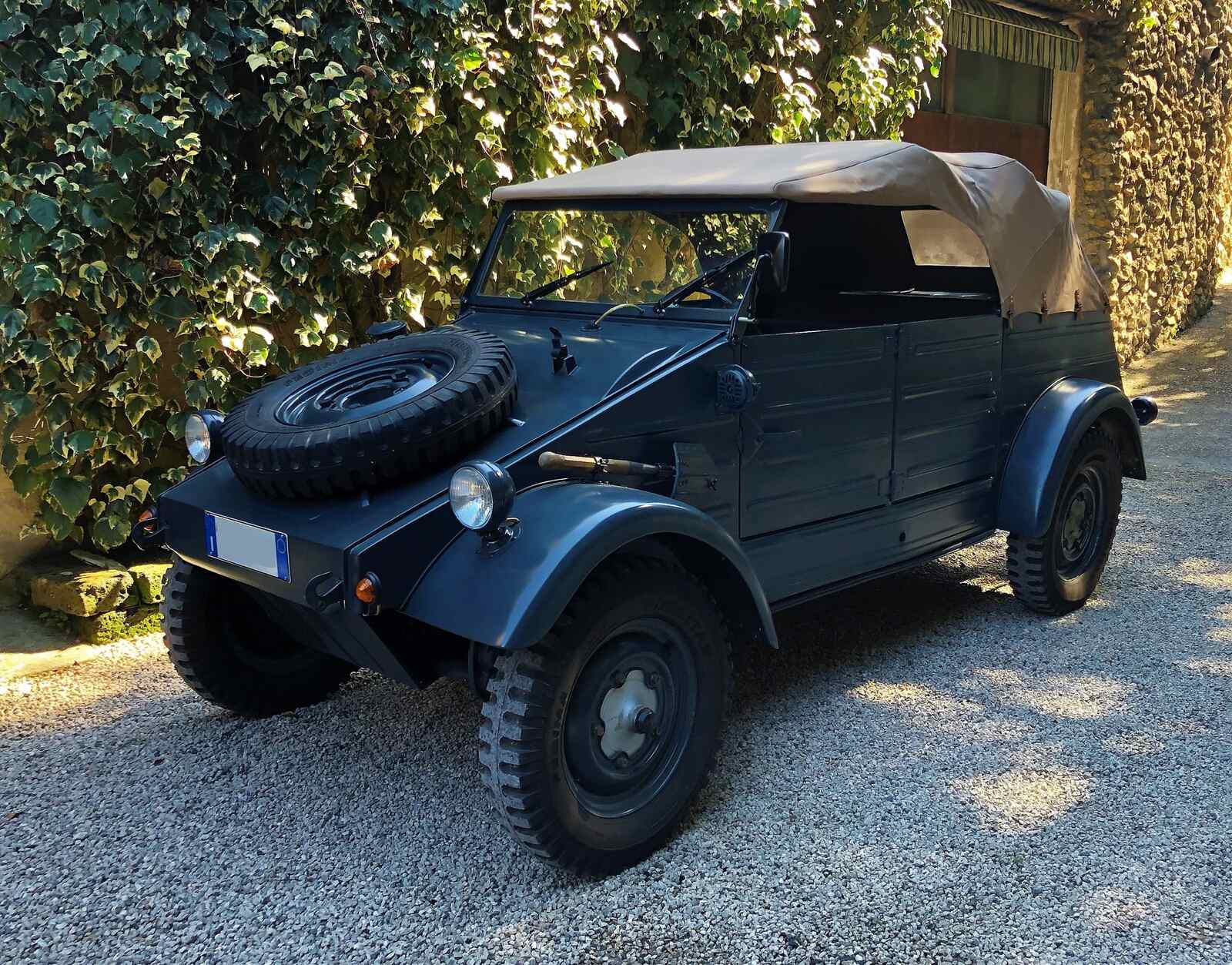
The 1943 Volkswagen Kübelwagen Type 82 is one of the most recognisable military vehicles of the Second World War, combining simple Volkswagen mechanical engineering with lightweight construction and remarkable off-road capability.
This specific 1943 Kübelwagen has been sold and is now part of the Giro Classico archive. The original page confirms that the vehicle was restored in 2017, is finished in Gunship Grey, carries Ambi-Budd Presswerk Berlin coachwork references and retains its original cable-operated braking system.
1943 Volkswagen Kübelwagen Type 82
The Type 82 was developed from the Volkswagen Beetle platform after the German military requested a light, inexpensive and reliable vehicle capable of operating both on and off road.
Production began in 1940 and continued until the end of the war, with more than 50,000 examples produced according to the historical information reported on the Giro Classico page.
Its engineering philosophy was intentionally simple:
- rear-mounted air-cooled engine
- rear-wheel drive
- low weight
- high ground clearance
- portal-style reduction gearing
- flat underbody
- minimal equipment
- easy field maintenance
The result was a vehicle with surprisingly strong traction even without conventional four-wheel drive.
Designed by Ferdinand Porsche and Erwin Komenda
Giro Classico identifies the Kübelwagen as a project associated with Ferdinand Porsche and Erwin Komenda.
The design shared important principles with the Volkswagen Beetle, but the military body and chassis configuration were developed specifically for utility and off-road use.
Its low weight was a major advantage. Rather than relying on heavy four-wheel-drive hardware, the Kübelwagen used:
- rear-mounted engine weight over the driven wheels
- generous ground clearance
- reduction gearing
- lightweight bodywork
- narrow tyres capable of finding traction on loose surfaces
The 1943 specification
The year 1943 is particularly relevant because the Type 82 received an updated 1,131 cc engine from March of that year, developed from the unit used in the Schwimmwagen and offering more torque than the earlier 985 cc engine.
The Giro Classico page also notes that the dashboard was revised during this period.
However, this specific vehicle does not retain its original wartime engine.
Replacement D-series engine
The original two-piece engine had been removed earlier in the vehicle’s life.
During restoration, the car received a fully rebuilt Volkswagen D-series engine from the 1960s, chosen to improve reliability and usable performance.
This distinction should be stated clearly because originality is an important factor in military-vehicle collecting.
The car therefore offers:
- authentic Type 82 identity
- period body and chassis configuration
- correct cable braking system
- restored wartime appearance
- later Volkswagen replacement engine
For some buyers, this improves usability; for others seeking absolute originality, the non-original engine is an important consideration.
Ambi-Budd coachwork
The Giro Classico description refers to Ambi-Budd Presswerk Berlin coachwork emblems and identifies the vehicle as produced in 1943.
On military vehicles, details such as:
- body manufacturer markings
- chassis numbers
- production stamps
- military fittings
- dashboard configuration
- seat frames
- lighting
- hardware
can have a major influence on authenticity and collector value.
Frame-off restoration
The car was acquired by its previous owners in 2015 and underwent a two-year frame-off restoration completed in 2017.
The work included:
- body removal from the chassis
- sandblasting
- structural repairs
- body alignment
- replacement of brake steel casings
- front axle rebuilding
- engine rebuilding
- interior retrimming
The body was described by Giro Classico as rust-free and correctly aligned after restoration.
Original cable-operated brakes
One particularly interesting feature retained during the restoration is the original mechanical cable brake system.
Rather than hydraulic brakes, early Volkswagens used cable-operated braking, reflecting the simple engineering philosophy of the period.
During restoration, the brake steel casings were renewed to ensure correct operation while maintaining the original system.
Gunship Grey finish
The vehicle was restored in Gunship Grey, a colour selected to reproduce an appropriate Wehrmacht appearance.
For military vehicles, presentation should always be distinguished from documented factory specification.
Colour, markings and accessories should ideally be supported by:
- production records
- period photographs
- surviving paint traces
- military documentation
This is especially important when evaluating restored examples.
Interior restoration
The upholstery was remade using fabric described by Giro Classico as corresponding to the original type.
On a Kübelwagen, interior authenticity can depend on small details such as:
- seat material
- stitching
- seat frames
- dashboard
- controls
- steering wheel
- switches
- storage fittings
Because so many wartime vehicles were modified after 1945, these details deserve careful inspection.
Restoration documentation
The restoration is supported by a photographic dossier, an important asset for a vehicle of this type.
A good photographic record can help establish:
- condition before restoration
- structural repairs
- chassis identity
- body originality
- mechanical work
- parts replaced
- paint preparation
For a military vehicle, documentation is especially valuable because reconstructions using mixed components are relatively common.
What to inspect before buying a Kübelwagen
A specialist inspection should include:
- chassis number
- production date
- body markings
- corrosion
- previous structural repairs
- engine type and number
- gearbox
- portal reduction boxes
- cable brakes
- front axle
- steering
- suspension
- body panels
- military fittings
- dashboard configuration
- wiring
- seats
- wheels
- restoration documentation
The key question is not simply whether the vehicle looks correct, but how much of its historical configuration can be verified.
Originality versus usability
Collectors approach Kübelwagens in different ways.
A highly original wartime example may have greater historical importance, while a correctly restored vehicle with a later Volkswagen engine can offer easier road use and maintenance.
This particular car falls into the second category: it preserves the important Type 82 architecture and wartime appearance, while the later rebuilt engine improves practicality.
Why the Volkswagen Type 82 is collectible
The Kübelwagen is historically significant because it combines:
- Volkswagen engineering
- Ferdinand Porsche design influence
- wartime history
- highly distinctive bodywork
- unusual off-road capability
- mechanical simplicity
- strong museum and military-collection appeal
It also provides a fascinating contrast with later Porsche sports cars, showing how some of the same engineering minds worked on radically different vehicles.
This 1943 Kübelwagen has been sold
This specific 1943 Volkswagen Kübelwagen Type 82 is no longer available. Giro Classico confirms the vehicle’s SOLD status and keeps the page online as part of its archive of previously handled collector vehicles.
Looking for another Kübelwagen or historic military vehicle?
There is currently no directly comparable military vehicle in the Giro Classico inventory.
For this reason, the most relevant commercial path is specialist sourcing, rather than linking to an unrelated sports car.
Giro Classico can assist with the search for:
- Volkswagen Type 82 Kübelwagen
- Volkswagen Type 166 Schwimmwagen
- early Volkswagen military vehicles
- historic utility vehicles
- significant European military classics
- rare Volkswagen collector vehicles
The process can include:
- private and off-market sourcing
- chassis and body verification
- originality assessment
- restoration analysis
- pre-purchase inspection
- valuation
- negotiation
- international transport
Discover Giro Classico’s Collector Car Advisory service
For further information regarding sourcing a Volkswagen Kübelwagen Type 82, assessing originality, verifying a restoration or arranging specialist inspection and international transport, please contact us directly.
Because in the end, we never truly own these cars, we simply preserve them for the next generation.
Follow us on Instagram: @giro.classico